Loading advertisement...
Advertisement Popup
Advertisement content with navigation options
Loading advertisement...

03-10-2026
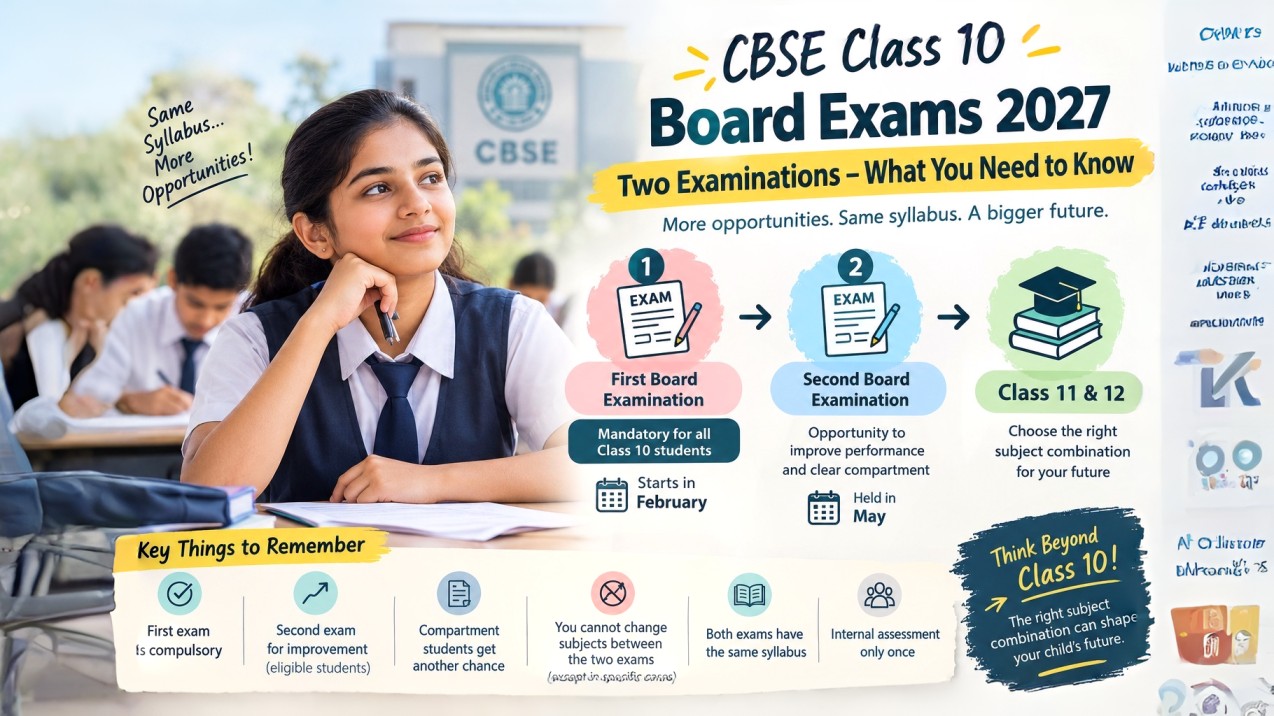
The Class 10 board examination is entering a new phase under CBSE.
From the 2026 examination onwards, the Central Board of Secondary Education (CBSE) introduced a system of two board examinations for Class 10. This system will continue for students appearing for the 2027 Class 10 board examinations.
While the new system gives students an additional opportunity, there are several misconceptions surrounding it.
One of the biggest misconceptions is:
“Students can choose either the first board exam or the second board exam.”
That is not how the system works.
Let us understand the CBSE Class 10 two-board-examination system in detail.
Two Board Examinations — But the First One Is Mandatory
Under the CBSE scheme, the first/main board examination is compulsory for all Class 10 students.
The main examination is scheduled to begin around mid-February, following the usual board-examination cycle. The second examination is conducted later, in May.
Therefore, students cannot simply skip the first examination and decide to appear only for the second one.
The first examination remains the main examination, and students are required to appear in it.
Then What Is the Purpose of the Second Board Examination?
The second examination provides an additional opportunity for eligible students.
A student who has passed the first examination but wants to **improve their performance** can appear again in the second examination.
According to CBSE's scheme, passed and eligible students can improve their performance in up to three subjects among Science, Mathematics, Social Science and languages.
This means the second examination can be particularly useful for students who feel that their first examination result does not reflect their expected performance.
For example:
A student scores 78 in Mathematics in the first examination but believes they can perform better.
If eligible, the student can use the second examination as an opportunity to improve their Mathematics performance.
The second examination is also relevant for students whose result in the first examination is placed in the Compartment category.
CBSE allows such students to appear in the second examination under the Compartment category.
This gives students another opportunity to meet the requirements for passing Class 10 without having to wait for the following year's main examination.
This is another area where parents and students need to be careful.
The general rule is that subject changes are not allowed between the first and second examinations except where specifically permitted under CBSE policy.
CBSE's 2025-26 implementation documents specifically provided an exception for Mathematics Standard and Mathematics Basic, allowing eligible students to switch between these two options for the second examination.
So students should not assume that the second examination gives them an opportunity to completely change their Class 10 subject combination.
Another important point is that both examinations are based on the full syllabus prescribed for the academic year.
CBSE has stated that the syllabus and scheme of examination remain the same for both examinations.
So the second examination should not be treated as an easier or reduced-syllabus version of the first examination.
Students need to prepare the complete prescribed syllabus.
Internal assessment is conducted only once, before the main examination.
This means students do not get a completely new internal-assessment cycle for the second board examination.
Therefore, students should take their school-based assessments, projects and other internal components seriously throughout the academic year.
The first examination is compulsory.
CBSE has also specified that if a student does not appear in three or more subjects in the first examination, the student will not be permitted to appear in the second examination and will be placed in the Essential Repeat category, with the next opportunity being the following year's main examination.
So the second examination should never be viewed as a replacement for the first examination.
Under the CBSE scheme, the result of the first examination is expected to be declared in April, while the second examination result is expected in June.
CBSE has also stated that the performance from the main examination can be used for admission to Class XI if a student does not wish to appear for the second examination for improvement.
A passing document is issued after the second examination, and the merit certificate is also issued only after the second examination.
This is particularly important for students and parents planning their transition from Class 10 to Class 11.
CBSE has stated that students who are not qualified in the main examination can receive **provisional admission to Class XI**, with their admission being confirmed based on the result of the second examination.
Therefore, students and parents should not assume that a first-examination result automatically ends the student's Class XI options.
At the same time, the exact admission requirements can also depend on the school and the subject combination being selected.
The two-examination system is part of CBSE's broader move toward providing students with greater flexibility in assessment.
The CBSE Governing Body records state that the policy was introduced in alignment with the National Education Policy (NEP) 2020, with the objective of reducing examination pressure and providing students with multiple opportunities to demonstrate their learning.
Instead of treating one examination as the only opportunity to demonstrate performance, students now have another structured opportunity later in the academic year.
However, this additional opportunity should not lead to complacency.
The first examination is still compulsory, and students should prepare for it seriously.
For many students, Class 10 is not just about the board examination.
It is also the stage at which an important academic decision begins:
What should I study in Class 11 and 12?
Science, Commerce, Humanities, vocational subjects and different combinations within these streams can lead students toward very different academic pathways.
This is why subject selection should not be based only on:
- What friends are choosing
- What parents think is prestigious
- Which stream is considered “better”
- Which subjects seem easier
- What everyone else in the class is taking
Instead, students should consider their **interests, academic strengths, career goals, subject requirements for future courses and the options available at their school.
The Class 10 board examination and the transition to Class 11 are therefore closely connected decisions.
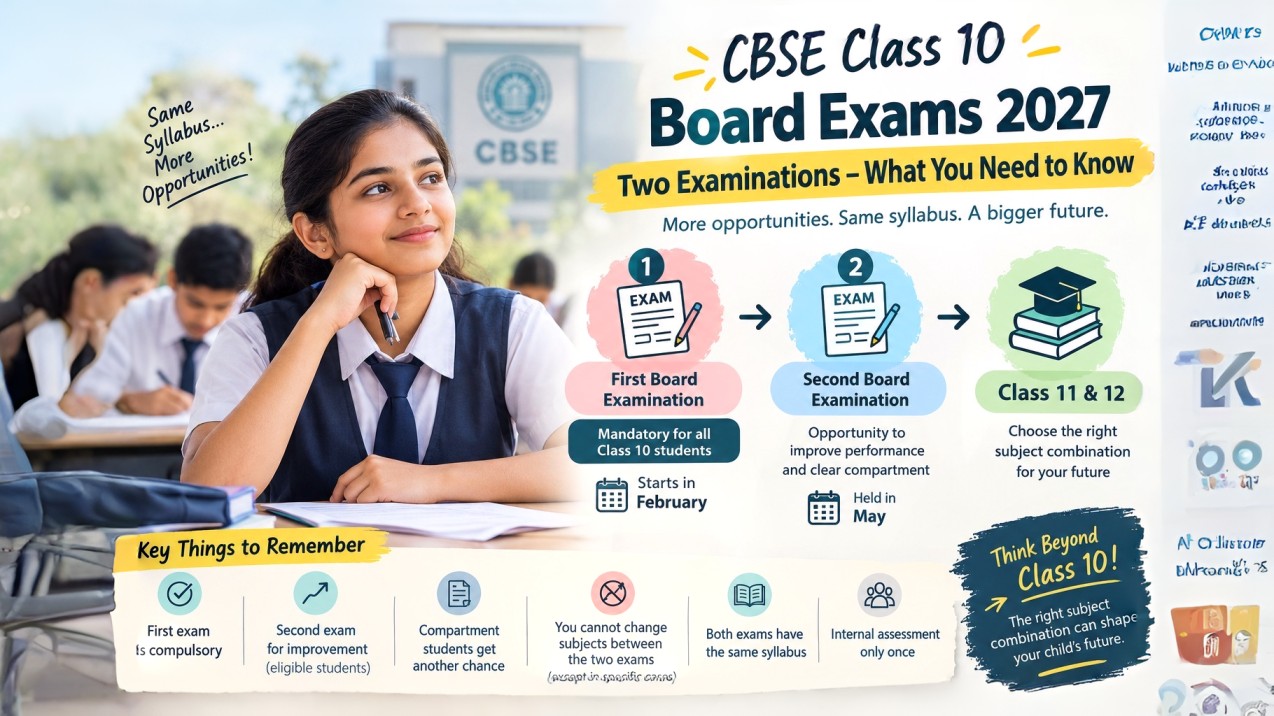
If your child is appearing for the CBSE Class 10 board examination in 2027, remember these key points:
1. The first board examination is compulsory.
2. The second examination provides an additional opportunity for eligible students.
3.Passed students can use the second examination to improve performance in eligible subjects.
4. Compartment students can also get an opportunity through the second examination.
5. Both examinations are based on the full syllabus.
6. Subject changes between examinations are generally not allowed, except where specifically permitted by CBSE policy.
7. Internal assessment is conducted only once.
8.Students should not treat the second examination as a substitute for preparing seriously for the first examination.
9.Students who are planning Class XI should start thinking about their subject combination well before the transition.
The introduction of two Class 10 board examinations gives students an additional opportunity, but it also makes it more important for parents and students to understand the rules correctly.
So, while preparing for the board examination, students should also begin asking:





.jpg)