Loading advertisement...
Advertisement Popup
Advertisement content with navigation options
Loading advertisement...


02-12-2025
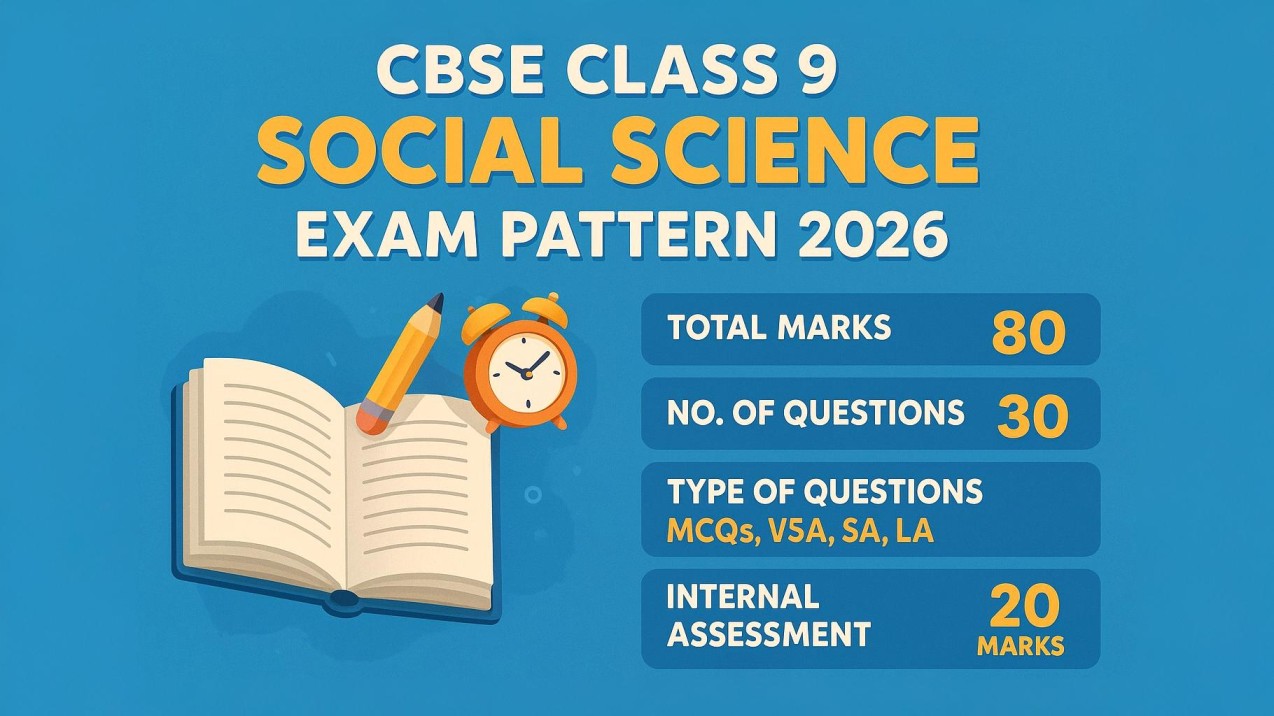
Social Science is one of the core subjects in Class 9, forming the base for Class 10 board preparation. For the academic year 2025–26, CBSE has continued its competency-based question pattern, along with an equal weightage distribution across History, Geography, Civics, and Economics.
This article provides a complete and in-depth guide to the CBSE Class 9 Social Science Exam Pattern 2026, including marking scheme, paper structure, topic-wise weightage, map work, internal assessment, study strategies, and more.
Most Class 9 students struggle in Social Science not because the subject is difficult, but because:
The annual examination includes:
| Section | Type of Questions | No. of Questions | Marks | Skills Tested |
|---|---|---|---|---|
| A | MCQs / Objective Type | 20 | 20 | Recall & Basic Understanding |
| B | Very Short Answer (2 marks) | 4 | 8 | Conceptual Understanding |
| C | Short Answer (3 marks) | 5 | 15 | Explanation & Clarity |
| D | Long Answer (5 marks) | 4 | 20 | Detailed Writing & Analysis |
| E | Case-Based / Source-Based | 3 sets | 12 | Critical Thinking |
| F | Map-Based (History + Geography) | 1 set | 5 | Practical & Visual Skills |
CBSE divides Class 9 Social Science into four books, each carrying equal weightage.
| Subject / Book | Marks | What’s Included |
|---|---|---|
| History – India and the Contemporary World – I | 20 | Revolutions, colonialism, nationalism |
| Geography – Contemporary India – I | 20 | Climate, drainage, vegetation, population |
| Political Science (Civics) – Democratic Politics – I | 20 | Democracy, constitution, elections |
| Economics | 20 | Poverty, resources, food security |
History – India and the Contemporary World – I (20 Marks)
This section helps students understand global events that shaped the modern world.
Important Chapters
A highly scoring subject if you understand diagrams & maps.
Chapters Included
Most Asked in Exams:
Civics – Democratic Politics – I (20 Marks)
Easy chapter-wise and mostly concept-based.
Chapters
Scoring Tips:
Economics (20 Marks)
Very practical and easy to score.
Chapters
How to Score More:
Internal Assessment (20 Marks)
This is where students can secure FULL marks.
Internal Assessment Breakup:
Map questions are asked from both:
History
Geography
Here are expert-level strategies:
✔ Make a 4-column notebook (Chapter Summary + Key Facts + Diagrams + Case Studies)
✔ Solve at least 3 sample papers
✔ Practice 2 long answers daily
✔ Prepare one-page revision sheets for each chapter
✔ Use NCERT keywords and definitions
✔ Time-yourself while writing long answers
1. What type of questions does CBSE ask in the Social Science exam?
CBSE asks MCQs, short answers, long answers, case-based questions, and map-based questions. Case-based questions may include data, charts, pictures, and sources.
2. Is NCERT enough for Class 9 Social Science?
Yes. NCERT is the ONLY official source. Questions are directly asked from it. Use extra books only for practice.
3. How many hours should Class 9 students study SST?
At least 1 hour per day, and 2-3 hours per week for map practice.
4. How to write long answers effectively?
5. Is there a choice in the SST paper?
Yes, usually internal choice is provided in long answers and source-based questions.
The CBSE Class 9 Social Science Exam Pattern 2026 is balanced and student-friendly. With proper planning, consistent revision, and map practice, scoring 70–80 marks is very achievable.
Use this guide to structure your preparation and ensure you cover all subjects equally.
✅Stay connected with Skool Guru for more educational tips, exam strategies, and academic guidance.
📞 Need help? Contact our mentors today!
Visit: www.skoolguru.in




.jpg)