Loading advertisement...
Advertisement Popup
Advertisement content with navigation options
Loading advertisement...
27-11-2026
https://www.skoolguru.in/blogs/how-online-individual-tuition-supports-nsw-school-students
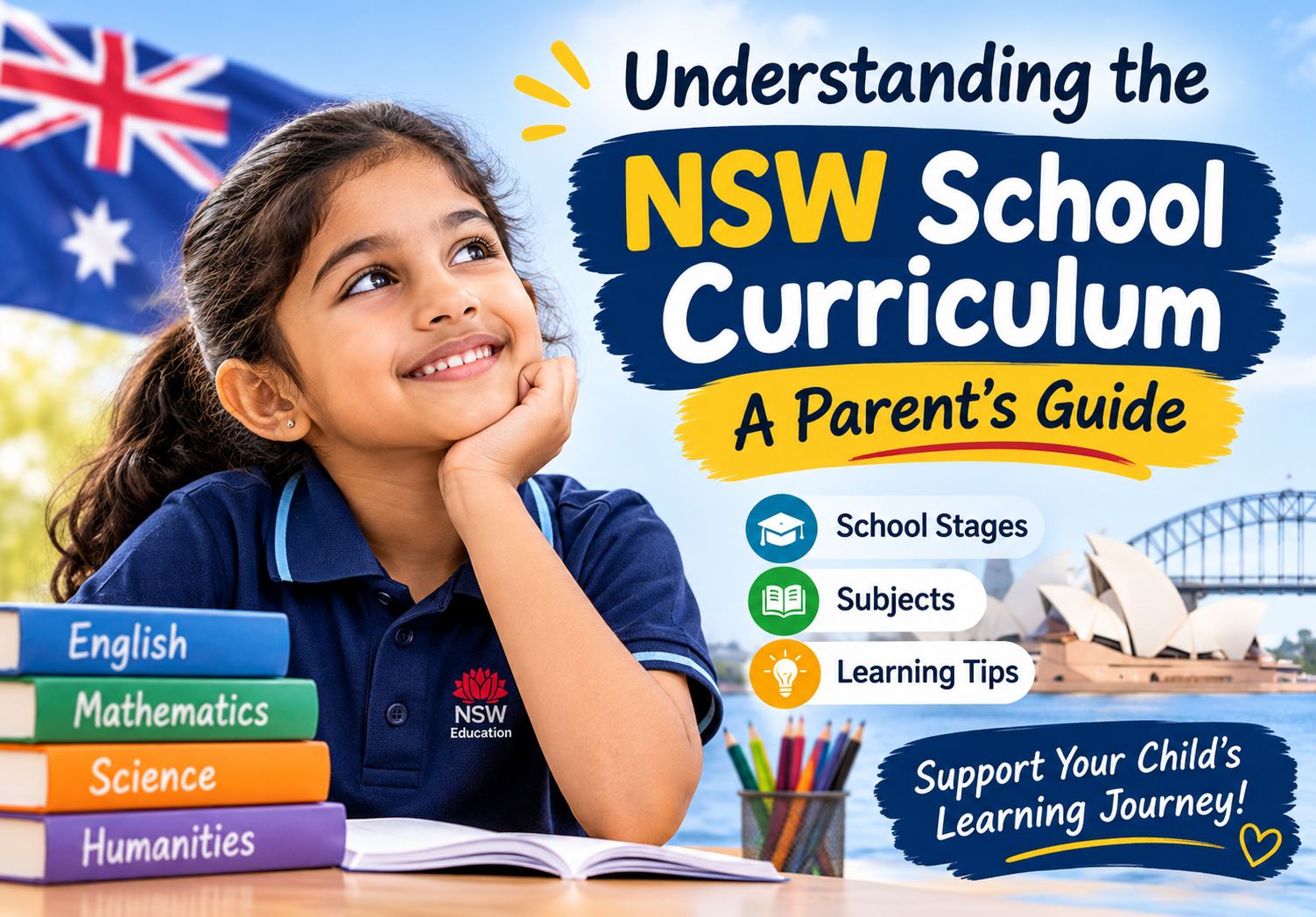
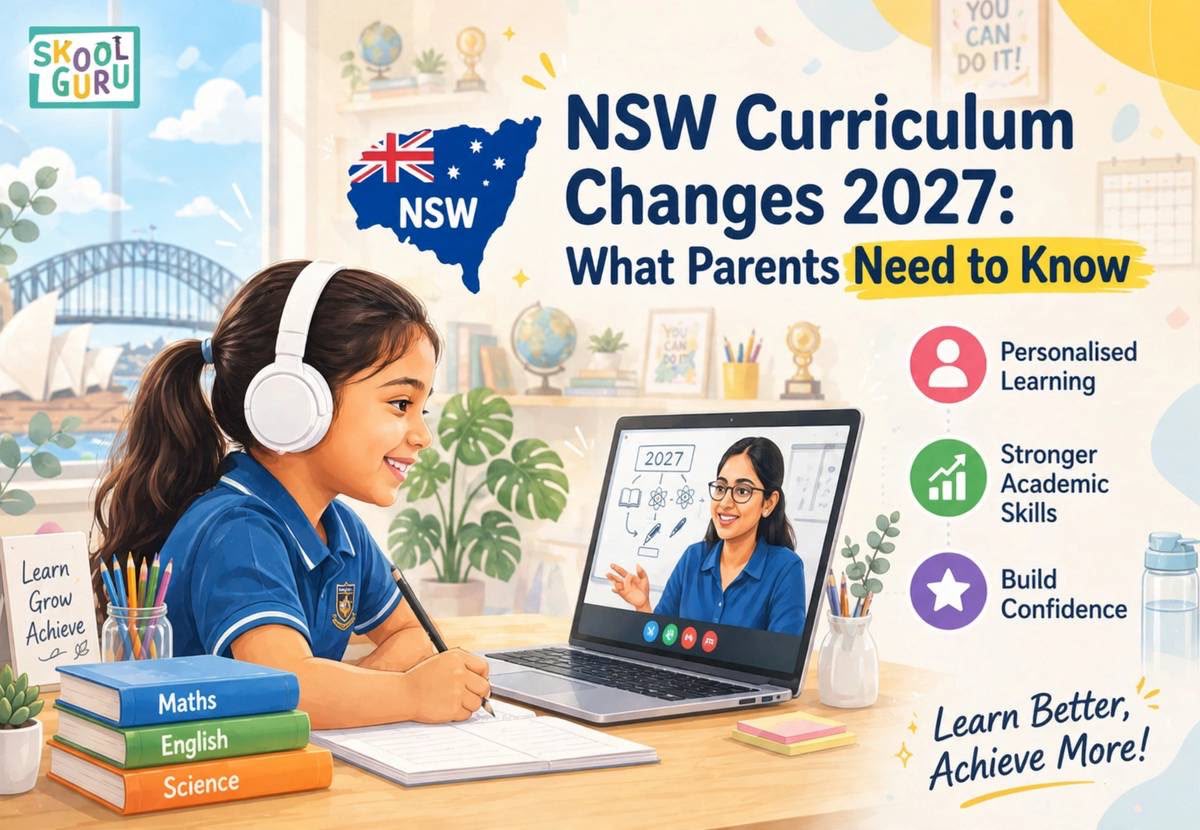
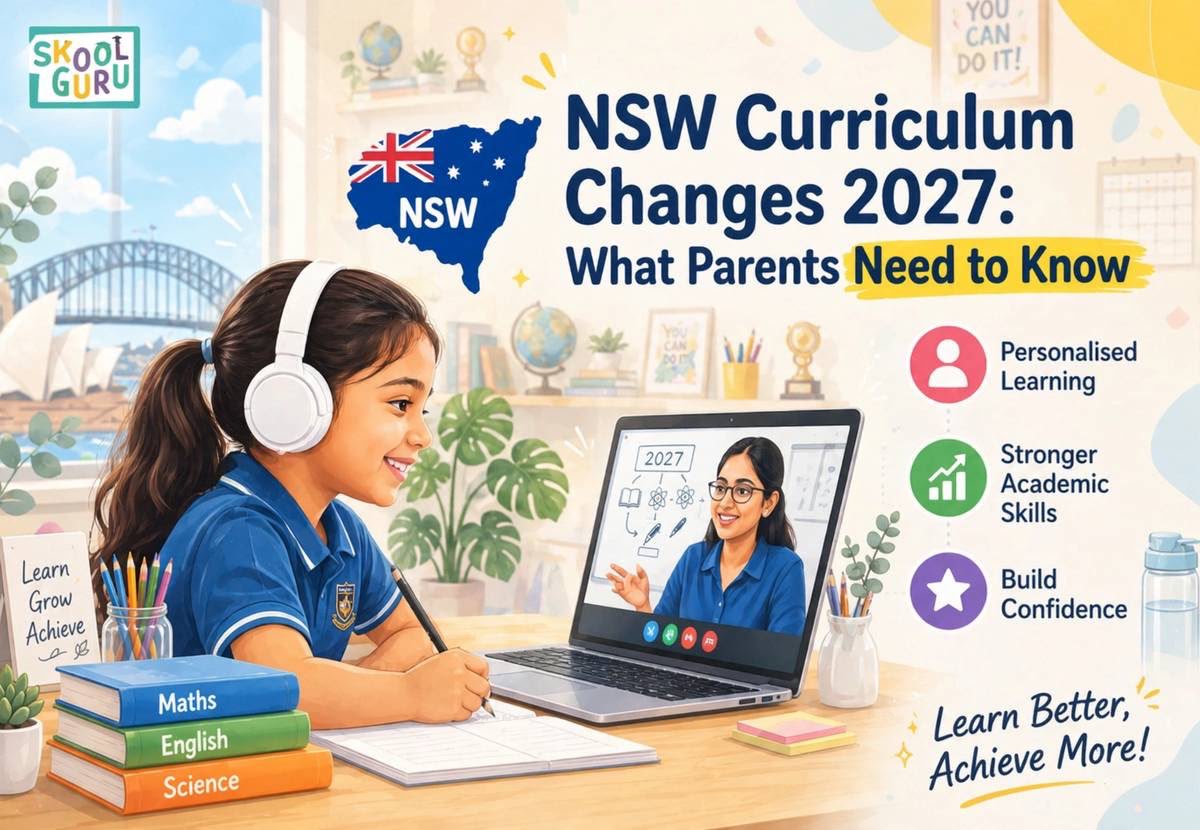
The New South Wales (NSW) education system is introducing important curriculum updates to help students develop stronger knowledge, practical skills and a deeper understanding of different subjects.
From 2027, NSW primary schools will implement updated syllabuses for four key learning areas: Creative Arts, Human Society and Its Environment (HSIE), Personal Development, Health and Physical Education (PDHPE), and Science and Technology.
These updates are part of the broader NSW Curriculum Reform, which aims to make learning more structured, clear and connected across different subjects.
But what exactly is changing? How could these updates affect your child's learning? And what should parents do to help children prepare?
Let's explore what families need to know about the NSW Curriculum changes in 2027.
The NSW Education Standards Authority (NESA) has been updating school syllabuses to provide clearer learning expectations and a stronger foundation for students.
For primary school students from Kindergarten to Year 6, four updated syllabuses are scheduled for implementation in 2027:
Creative Arts K–6
Human Society and Its Environment (HSIE) K–6
Personal Development, Health and Physical Education (PDHPE) K–6
Science and Technology K–6
Schools have been given time to prepare for these changes, with the new syllabuses becoming mandatory from the beginning of Term 1, 2027.
It is important to understand that English and Mathematics have already moved to updated syllabuses in NSW primary schools. The 2027 implementation focuses on the four learning areas listed above.
Let's look at the four updated learning areas and what they mean for primary school students.
Creative Arts helps children express ideas, explore their imagination and develop creative thinking skills.
The updated syllabus covers four main areas:
Dance
Drama
Music
Visual Arts
Students will have opportunities to explore different forms of artistic expression, develop creative skills and understand how people communicate through art.
How does this benefit children?
Creative Arts can help students develop:
Creativity and imagination
Communication skills
Confidence in expressing ideas
Collaboration and teamwork
Appreciation of different cultures and artistic styles
HSIE helps children understand the world around them, including people, places, communities and societies.
It includes learning areas such as History and Geography.
Students explore topics related to:
Australian history and heritage
Different communities and cultures
People and places
The environment
How societies change over time
Connections between people and their surroundings
How does this benefit children?
HSIE encourages students to become curious about the world. It also supports the development of research, observation, communication and critical-thinking skills.
PDHPE focuses on students' physical, social and emotional development, as well as their understanding of health and wellbeing.
Children learn about topics such as:
Healthy lifestyle choices
Physical activity and movement
Personal safety
Relationships and social skills
Emotional wellbeing
Teamwork and cooperation
How does this benefit children?
PDHPE helps students understand the importance of healthy habits, responsible decisions and positive relationships.
It also provides opportunities to develop physical skills and confidence through movement and physical activities.
Science and Technology encourages children to explore how the world works through observation, investigation and practical learning.
Students develop an understanding of scientific concepts and how technology can be used to solve problems.
Learning may involve:
Living things and their environments
Materials and their properties
Earth's systems and natural processes
Forces, energy and movement
Scientific investigation
Designing and developing solutions
How does this benefit children?
Science and Technology supports curiosity, logical thinking, problem-solving and creativity.
Instead of simply memorising facts, students are encouraged to ask questions, investigate ideas and understand how things work.
This is an important question for parents.
English and Mathematics are also part of the NSW Curriculum Reform. However, their updated K–10 syllabuses have already been introduced in schools.
The updated English syllabus focuses on areas such as:
Reading and comprehension
Writing and communication
Vocabulary development
Grammar and language skills
Literature and text understanding
The updated Mathematics syllabus focuses on:
Number and algebra
Measurement and space
Statistics and probability
Mathematical reasoning
Problem-solving skills
These subjects continue to be essential parts of primary education. Parents should check with their child's school for the specific learning expectations and teaching sequence for each year level.
The updated curriculum aims to make learning more connected, structured and meaningful.
Some important learning benefits include:
Stronger subject knowledge: Students are supported in developing a clearer understanding of important concepts.
Better connections between subjects: Children can apply what they learn in one subject to other areas. For example, mathematical skills such as reading graphs can also be useful in Science and Geography.
More opportunities for practical learning: Investigation, creative activities and real-world examples can help students connect classroom knowledge with everyday experiences.
Development of critical thinking: Students are encouraged to explore ideas, ask questions and understand concepts rather than simply memorising information.
Parents do not need to worry about the curriculum changes. However, staying informed and supporting children's learning at home can make the transition easier.
Here are some simple ways to help:
Stay informed: Follow updates and announcements shared by your child's school.
Strengthen foundational skills: Support regular reading, writing and Mathematics practice.
Encourage curiosity: Allow children to ask questions and explore topics they find interesting.
Include practical activities: Use everyday experiences to introduce Science, measurement, observation and problem-solving.
Discuss school learning: Ask children what they have learned and encourage them to explain concepts in their own words.
Identify learning difficulties early: If your child consistently struggles with a topic, speak with their teacher and explore suitable learning support.
Even when school syllabuses are updated, one thing remains important: children need strong foundational skills to progress confidently.
For example:
Reading skills help students understand questions and instructions across subjects.
Writing skills help children communicate their ideas clearly.
Mathematical understanding supports logical reasoning and problem-solving.
Scientific curiosity encourages investigation and independent thinking.
If children have difficulty with basic concepts, they may find more advanced learning challenging.
That is why regular practice, concept clarity and individual attention can make a meaningful difference.
https://www.skoolguru.in/blogs/how-online-individual-tuition-supports-nsw-school-students
At Skool Guru, we understand that every child has a different learning pace and may need support in different areas.
Our individual online tuition aims to help students strengthen their foundations in subjects such as English and Mathematics.
Our learning approach includes:
One-to-one online classes
Personalised teaching based on the child's learning level
Concept-based English and Mathematics support
Practice aligned with the student's school syllabus and current learning needs
Step-by-step explanations and problem-solving activities
Regular learning progress evaluation
Updates for parents about their child's progress
We focus on helping children understand what they learn, build confidence and develop skills that support their overall academic progress.
The NSW Curriculum changes coming in 2027 are an important step in the ongoing development of primary education across New South Wales.
With updated syllabuses in Creative Arts, HSIE, PDHPE, and Science and Technology, students will have opportunities to develop knowledge and skills across a wider range of learning experiences.
For parents, the most important step is to stay informed, encourage curiosity and support children in building strong learning foundations.
Remember, successful learning is not just about completing schoolwork. It is about understanding concepts, asking questions and developing skills that children can use throughout their lives.
At Skool Guru, we believe every child deserves the right guidance to build strong foundations and become a confident learner!
.jpg)