Loading advertisement...
Advertisement Popup
Advertisement content with navigation options
Loading advertisement...


28-11-2026
https://www.skoolguru.in/blogs/nsw-curriculum-changes-2027-what-parents-need-to-know
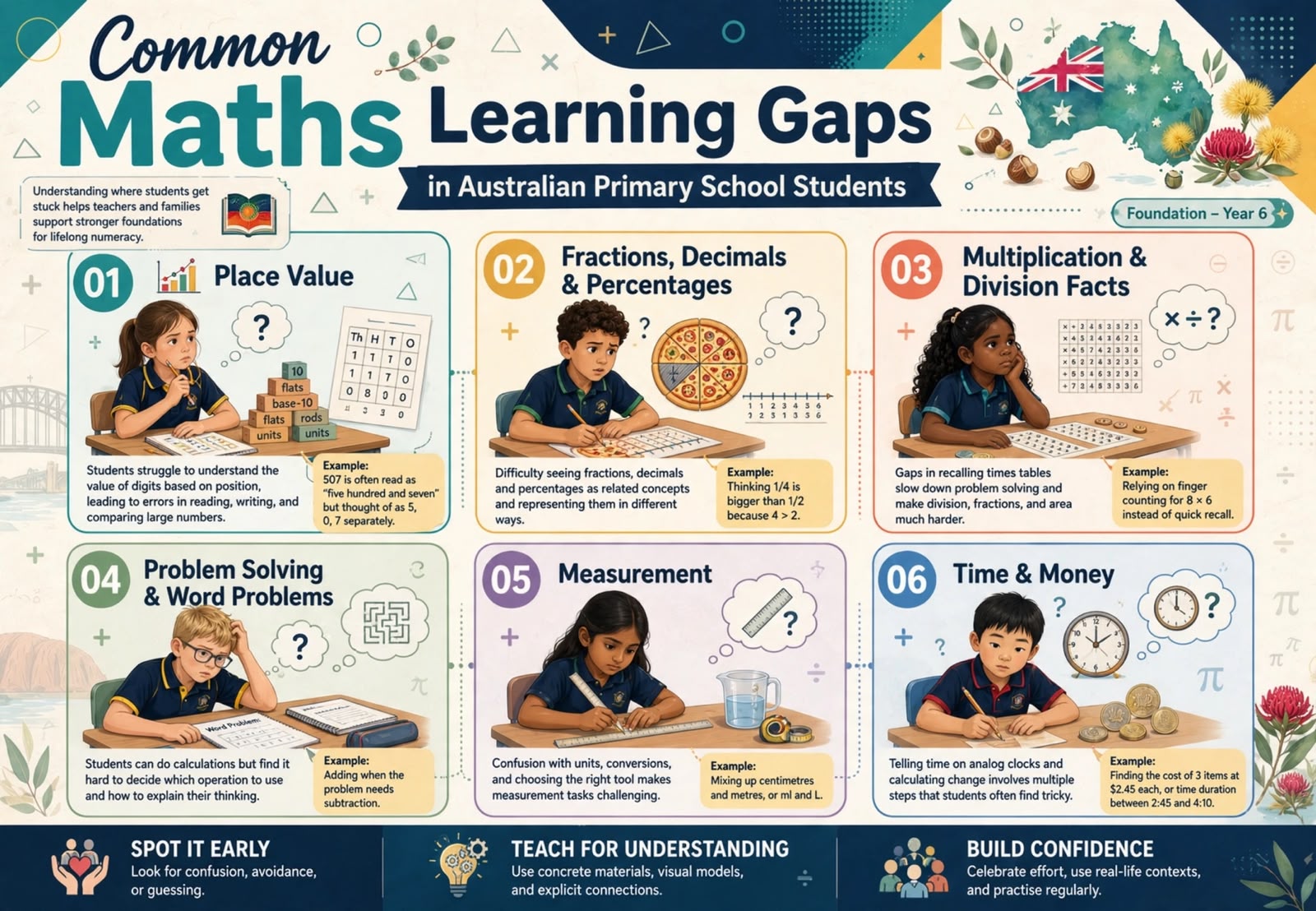
Mathematics is one of the most important subjects in a child's early education. From basic counting and addition to multiplication, division and problem-solving, every new concept builds on previously learned skills.
However, not every child develops mathematical understanding at the same pace. Some students may move to the next school year without fully understanding certain basic concepts. Over time, these small learning gaps can make advanced topics more challenging.
For Australian primary school students, especially those following the NSW curriculum, developing strong mathematical foundations is essential for success in later years.
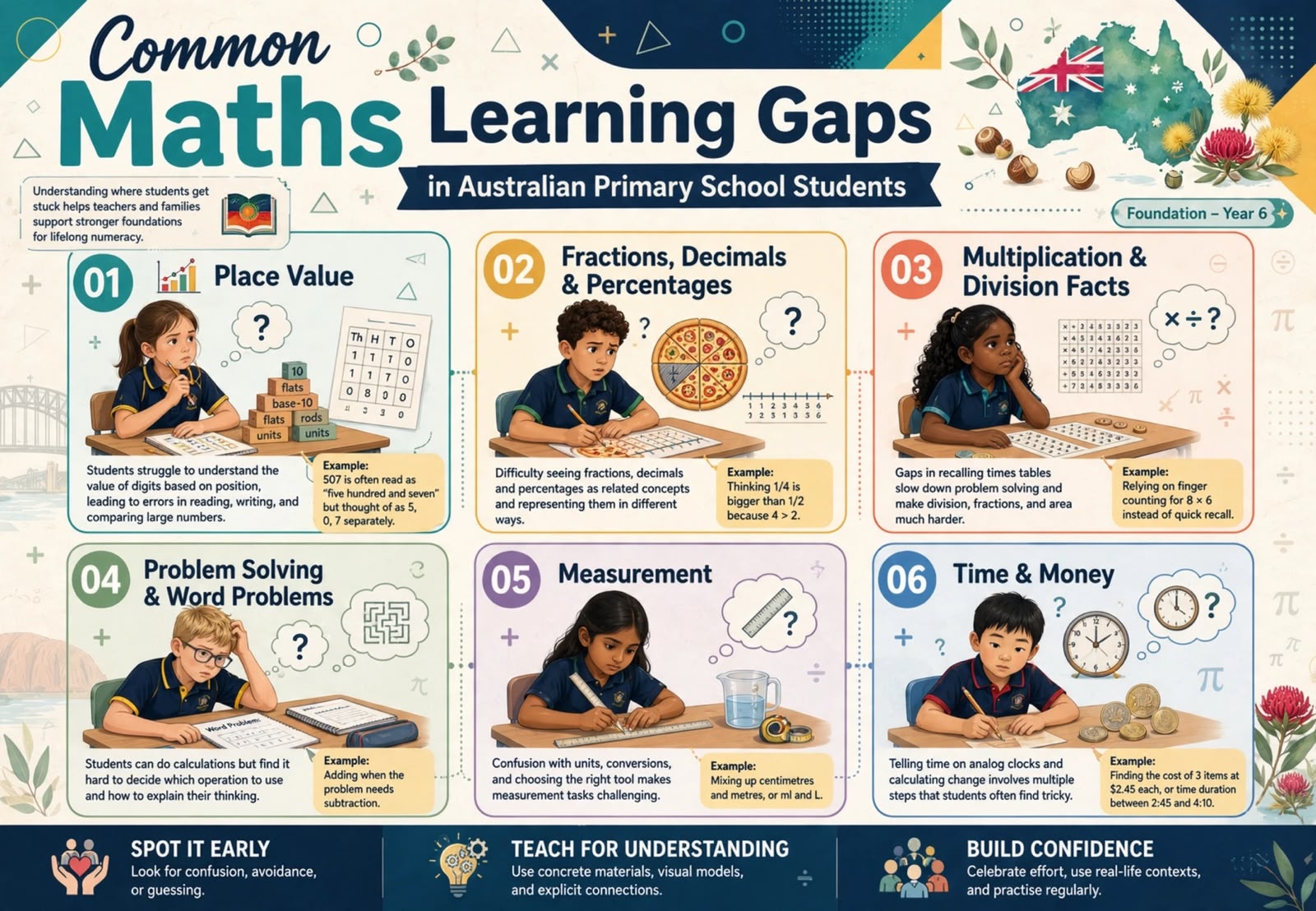
Let's explore some common maths learning gaps, why they happen and how parents can support their children.
Number sense is the ability to understand numbers, their values and how they relate to each other.
Some children can read and write numbers but struggle to understand what each digit represents.
For example:
In 245, 2 represents 200.
4 represents 40.
5 represents 5.
A child who does not understand place value may find addition, subtraction, multiplication and larger numbers difficult.
How parents can help:
Practise counting forwards and backwards.
Use everyday objects to demonstrate numbers.
Introduce hundreds, tens and ones using visual examples.
Encourage children to compare and arrange numbers.
Addition and subtraction are essential mathematical skills. Children need to understand these operations before moving on to more advanced calculations.
Some common difficulties include:
Forgetting number facts.
Struggling with carrying and borrowing.
Confusing addition and subtraction.
Finding mental calculations difficult.
For example, a child may know that 8 + 5 = 13 but struggle to solve 28 + 15.
How parents can help:
Practise simple calculations regularly.
Use objects such as pencils, blocks and toys.
Introduce mental maths activities.
Encourage children to explain how they found an answer.
Multiplication and division become increasingly important as children progress through primary school.
Some students memorise multiplication tables but do not understand what multiplication actually means.
For example:
4 × 3 means 4 groups of 3.
If children understand multiplication as repeated addition, they can develop a stronger foundation for solving problems.
Common learning difficulties include:
Forgetting multiplication tables.
Confusing multiplication and division.
Struggling with word problems.
Difficulty understanding equal groups.
How parents can help:
Practise multiplication tables through games.
Use real-life examples such as sharing fruits.
Introduce multiplication using groups of objects.
Connect multiplication with division.
Fractions can be challenging because children need to understand parts of a whole.
For example, when a pizza is divided into four equal pieces, each piece represents 1/4.
Some common difficulties include:
Understanding numerator and denominator.
Comparing fractions.
Recognising equivalent fractions.
Adding and subtracting fractions.
How parents can help:
Use pictures of pizzas, chocolates and fruits.
Practise identifying halves, quarters and thirds.
Use fraction strips and visual models.
Introduce simple fraction comparisons.
Measurement is an important part of everyday mathematics.
Children learn to measure length, weight, capacity and time. However, some students struggle to understand measurement units and conversions.
Examples include:
Confusing centimetres and metres.
Difficulty understanding grams and kilograms.
Confusing litres and millilitres.
Struggling with time calculations.
How parents can help:
Let children measure household objects.
Compare the weights of different items.
Use measuring cups during cooking.
Practise reading clocks and calendars.
Some children can solve mathematical calculations but struggle when the same calculations are presented as word problems.
For example:
"Riya has 12 apples. She gives 5 apples to her friend. How many apples does she have left?"
A child needs to understand the question, identify the information and choose the correct mathematical operation.
Common difficulties include:
Understanding the question.
Identifying important information.
Choosing the correct operation.
Explaining the answer.
How parents can help:
Encourage children to read questions slowly.
Ask them to identify the given numbers.
Use drawings to understand the problem.
Encourage them to explain their thinking.
Not all maths difficulties are caused by a lack of knowledge. Sometimes children understand a concept but feel nervous when solving questions.
This may happen because they:
Are afraid of making mistakes.
Find timed activities stressful.
Compare their performance with classmates.
Have difficulty understanding classroom explanations.
How parents can help:
Encourage effort rather than focusing only on marks.
Allow children enough time to solve problems.
Celebrate small learning improvements.
Create a comfortable learning environment.
There can be several reasons behind learning gaps:
Missed foundational concepts: Children may move to advanced topics without fully understanding earlier concepts.
Different learning speeds: Every child learns at a different pace.
Limited practice: Mathematical skills require regular application.
Lack of individual attention: Some children need additional explanation and guided practice.
Difficulty applying concepts: Children may understand a formula but struggle to use it in real-life problems.
Parents can look for some common signs:
Difficulty solving basic calculations.
Frequent mistakes in multiplication and division.
Trouble understanding word problems.
Confusion with fractions and measurements.
Difficulty explaining how an answer was obtained.
Lack of confidence while attempting maths questions.
These signs do not necessarily mean a child is weak in mathematics. They may simply need more time, practice or a different teaching approach.
Individual online tuition can provide additional academic support for children who need help strengthening their mathematical foundations.
Unlike a large classroom, one-to-one learning allows teachers to focus on an individual student's understanding and progress.
At Skool Guru, our individual online tuition focuses on:
Identifying the child's existing learning gaps.
Revising important foundational concepts.
Explaining difficult topics through simple examples.
Providing personalised practice questions.
Improving problem-solving skills.
Monitoring learning progress.
Sharing progress updates with parents.
Our goal is to help children understand mathematics, develop confidence and gradually become independent learners.
Strong mathematical foundations play an important role in a child's academic journey. Small learning gaps in primary school can become bigger challenges when children move to more advanced topics.
With early identification, regular practice and the right learning support, children can strengthen their understanding and develop better mathematical skills.
Remember, every child learns differently. The goal is not to rush through the syllabus but to make sure every child understands what they learn.
https://www.skoolguru.in/blogs/common-maths-learning-gaps-in-australian-primary-school-students
At Skool Guru, we believe every child deserves individual attention and the opportunity to learn at their own pace.
Book a Free Assessment and Demo Class with Skool Guru and take the first step towards stronger mathematical foundations.



.jpg)