Loading advertisement...
Advertisement Popup
Advertisement content with navigation options
Loading advertisement...

23-10-2026
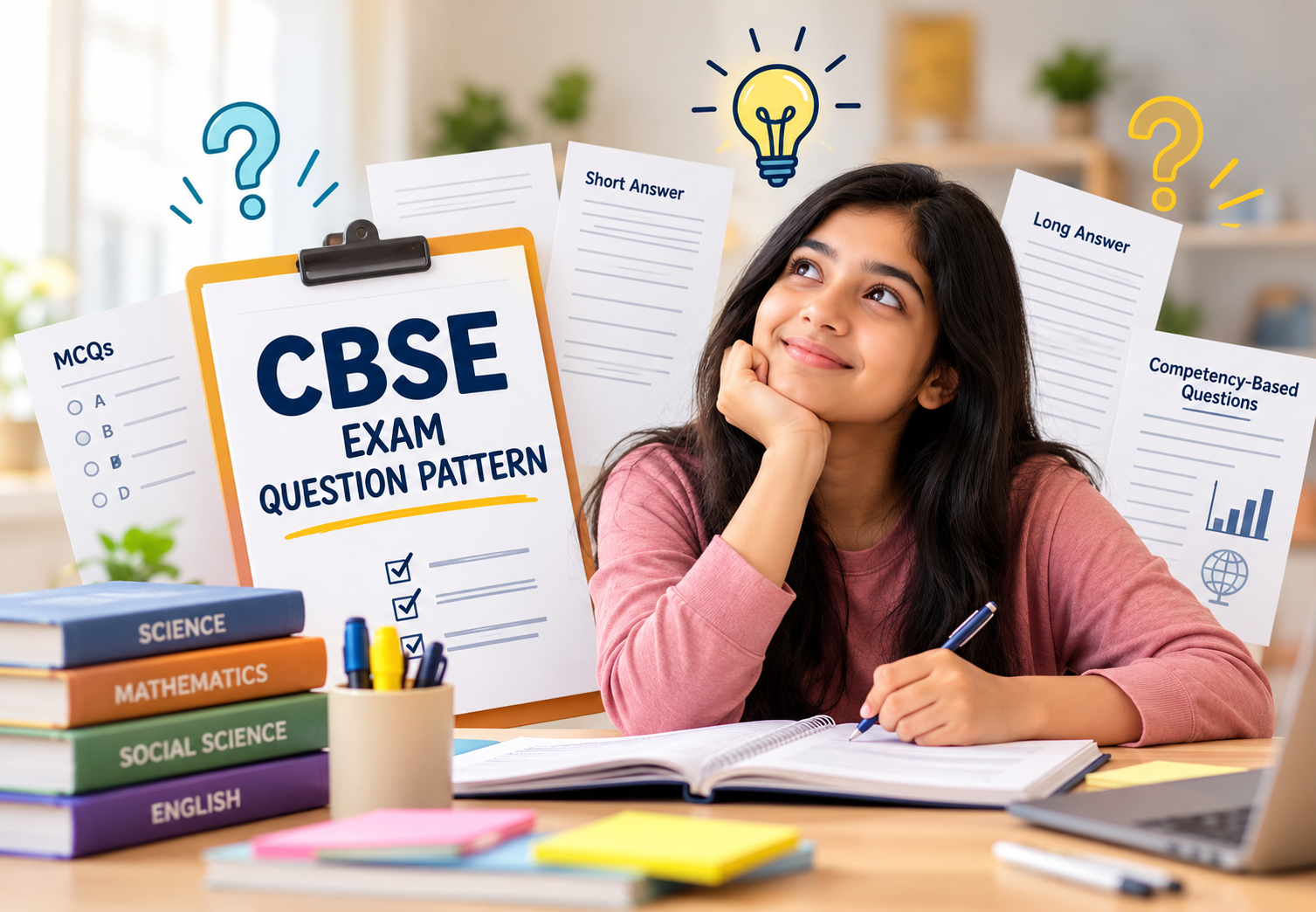
Understand the CBSE exam question pattern for Classes 10 and 12, including competency-based questions, MCQs, short answers, and long-answer questions.
Are CBSE board exams becoming more application-based?
Many students prepare for examinations by memorising textbook answers. However, CBSE assessments increasingly emphasise conceptual understanding, analytical thinking, and the practical application of knowledge.
Understanding the question paper pattern can help students prepare more effectively and approach examinations with confidence.
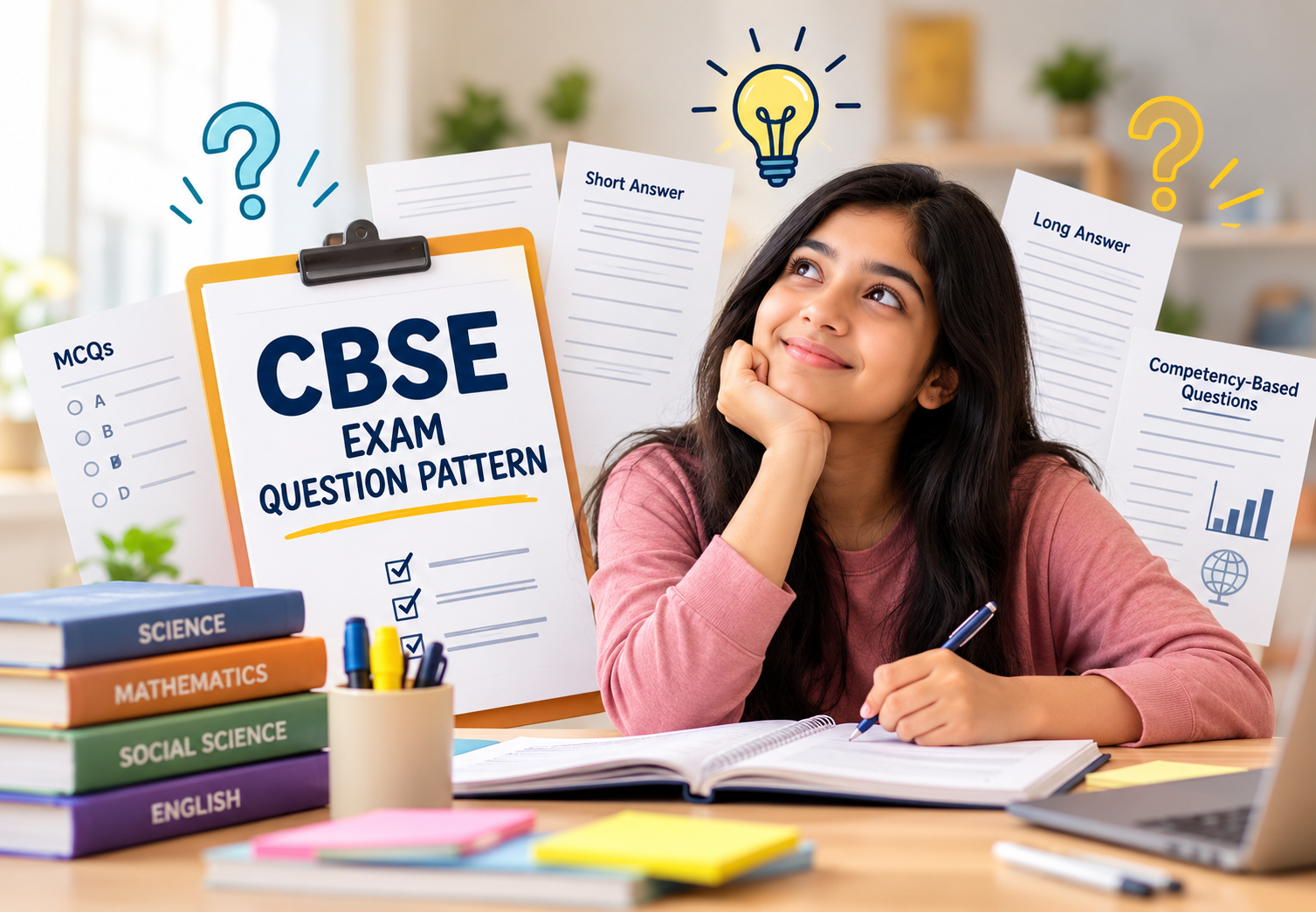
CBSE question papers generally include different types of questions to assess students' knowledge, understanding, and problem-solving abilities.
MCQs require students to select the correct answer from the given options.
These questions may test factual knowledge, conceptual understanding, or the ability to apply information.
Preparation Tip: Practise MCQs regularly and understand why each answer is correct.
Competency-based questions assess how well students can apply their knowledge to practical situations.
They may include:
Case-based questions
Source-based questions
Data interpretation
Real-life application questions
Analytical and reasoning questions
Preparation Tip: Focus on understanding concepts rather than memorising answers.
These questions require brief, accurate explanations.
Students should present important points clearly and use appropriate terminology.
Preparation Tip: Practise writing concise answers within the required word limits, where specified.
Long-answer questions assess detailed understanding, explanation, and the ability to organise information logically.
Preparation Tip: Structure answers with relevant points, explanations, examples, and diagrams where necessary.
https://www.skoolguru.in/blogs/cbse-class-10th-science-answer-key-2026-all-sets
These questions typically present two statements. Students must evaluate whether the statements are correct and whether the reason explains the assertion.
Preparation Tip: Understand the relationship between concepts instead of learning isolated facts.
Understand the syllabus: Identify important concepts and learning objectives for each chapter.
Practise sample papers: Use the latest official CBSE sample question papers and marking schemes.
Improve time management: Practise completing question papers within the allotted examination time.
Focus on application: Solve questions that require reasoning, interpretation, and problem-solving.
Review mistakes: Analyse incorrect answers to identify areas requiring additional practice.
At Skool Guru, we understand that every student has different learning needs.
Our personalised online tuition helps CBSE students strengthen their conceptual understanding and examination skills through:
One-to-one interactive classes
Concept-based teaching
Practice with different question formats
Previous-year question discussions
Doubt-clearing sessions
Regular revision and academic guidance
Understanding the CBSE question paper pattern is an important part of effective examination preparation.
Instead of depending entirely on memorisation, students should focus on conceptual clarity, consistent practice, and effective answer-writing skills.
With personalised learning support from Skool Guru, students can prepare confidently for their examinations.
Book a Free Demo Class with Skool Guru Today!