Loading advertisement...
Advertisement Popup
Advertisement content with navigation options
Loading advertisement...


24-10-2026
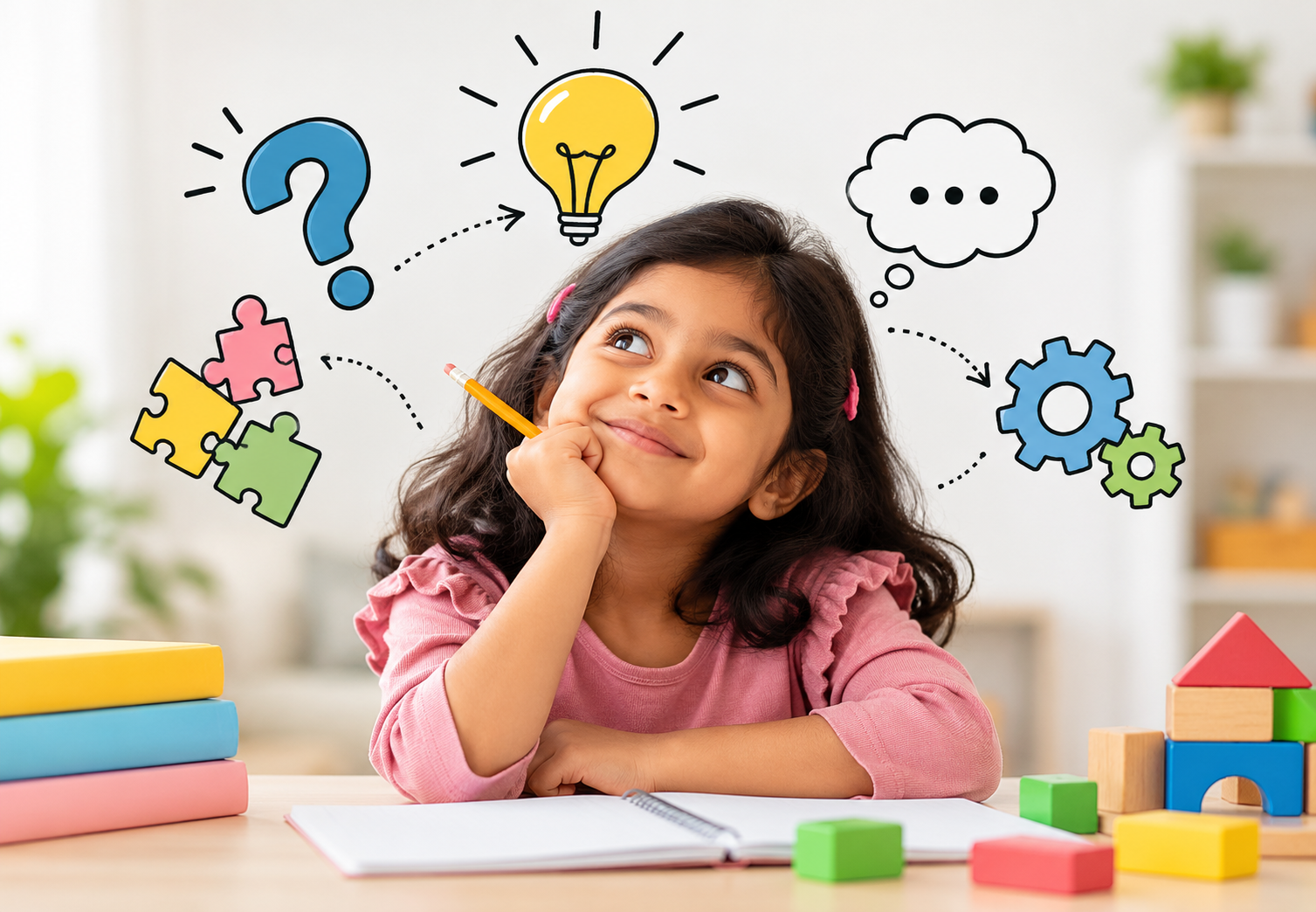
Every parent wants their child to become confident, independent, and capable of handling challenges. While academic success is important, one essential skill that often gets overlooked is problem-solving.
From solving a difficult maths question to managing disagreements with friends, children face different challenges every day. Learning how to approach these situations, think critically, and find solutions helps them become more independent and confident.
But how can parents develop problem-solving skills in their children? Let's explore some simple and effective strategies.
Problem-solving skills refer to the ability to identify a problem, understand its causes, explore possible solutions, and choose the most appropriate action.
For children, problem-solving doesn't always involve complicated situations. It can be as simple as figuring out how to complete a puzzle, organising their schoolwork, or finding another way to complete a task when their first attempt doesn't work.
These everyday experiences help children develop logical thinking, creativity, patience, and decision-making abilities.
Problem-solving is an essential life skill that supports both academic performance and personal development.
1. Builds Confidence and Independence
When children solve problems independently, they begin to trust their abilities. Each successful experience encourages them to approach new challenges with greater confidence.
2. Improves Critical Thinking
Problem-solving encourages children to analyse situations, ask questions, and think beyond memorised answers. This helps them understand concepts more deeply.
3. Encourages Creativity
Not every problem has a single solution. Children who practise problem-solving learn to explore different ideas and discover creative approaches.
4. Develops Decision-Making Skills
Children gradually learn to consider different options, understand possible consequences, and make thoughtful decisions.
5. Prepares Children for Real-Life Challenges
Whether they are dealing with school assignments, friendships, or everyday responsibilities, problem-solving skills help children approach difficulties calmly and constructively.
Parents naturally want to help their children whenever they face difficulties. However, providing immediate solutions to every problem can limit opportunities for independent thinking.
Instead, encourage children to try solving simple problems themselves.
For example, if a child struggles with a homework question, rather than giving the answer immediately, ask:
What do you already know about this question?
What do you think the first step should be?
Can you think of another way to solve it?
These questions encourage children to think independently and develop confidence in their abilities.
Children often learn more effectively when they actively participate in activities.
Puzzles, building blocks, memory games, and age-appropriate educational activities can encourage logical thinking and creativity.
For example, solving a jigsaw puzzle requires children to observe patterns, identify suitable pieces, and try different approaches.
Such activities make problem-solving enjoyable while supporting cognitive development.
Mistakes are a natural part of learning.
When children make mistakes, parents should avoid immediately criticising them or focusing only on the result.
Instead, help them understand what went wrong and encourage them to try again.
For example, if a child gets a maths answer wrong, ask them to review the steps and identify where the mistake happened.
This approach teaches children that challenges can be overcome through patience, practice, and learning.
Problem-solving doesn't have to be limited to textbooks or classrooms.
Everyday activities provide valuable opportunities for children to practise making decisions.
For example, parents can involve children in planning their daily schedules, organising school supplies, or deciding how to complete household tasks.
If a child has several assignments to finish, encourage them to think about which task should be completed first and how to manage their time.
These small responsibilities gradually improve planning, organisation, and decision-making skills.
Curiosity plays an important role in developing problem-solving abilities.
Children naturally ask questions about the world around them. Parents should encourage this curiosity rather than discourage repeated questions.
Questions such as "Why does this happen?", "How does this work?", and "What would happen if we tried something different?" encourage exploration and deeper understanding.
When children feel comfortable asking questions, they become more active participants in their learning.
Sometimes, children feel overwhelmed when they face a difficult task.
Teaching them to divide a large problem into smaller, manageable steps can make the task easier.
For example, if a child finds writing an essay difficult, encourage them to:
Understand the topic.
Identify the main ideas.
Organise those ideas.
Write one paragraph at a time.
Review the completed work.
This step-by-step approach helps children handle challenging assignments more confidently.
Children need encouragement throughout the learning process.
Instead of praising only correct answers or successful outcomes, parents should recognise the effort children put into solving problems.
Simple words such as "I like how you tried a different method" or "You worked hard to figure that out" can motivate children to keep learning.
Recognising effort helps children understand that progress and persistence are just as important as achieving the correct answer.
Teachers play an equally important role in helping children become independent thinkers.
An effective learning environment encourages students to ask questions, explore different methods, and understand concepts instead of simply memorising answers.
Interactive teaching methods, practical examples, and personalised guidance can help students develop stronger analytical and reasoning skills.
Every child learns differently. Some children understand concepts quickly, while others need additional explanations and practice.
Recognising these differences and providing appropriate support can make problem-solving activities more effective.
At Skool Guru, we believe that education should go beyond memorising lessons and preparing for examinations.
Our personalised one-to-one online tuition classes focus on helping students understand concepts, clarify doubts, and develop confidence in their learning abilities.
Through individual attention and interactive teaching methods, our experienced tutors encourage students to ask questions, practise independently, and approach academic challenges step by step.
By focusing on conceptual understanding and personalised support, Skool Guru aims to help children build a stronger foundation for academic success and lifelong learning.
Developing problem-solving skills in children is not about teaching them how to find the correct answer every time. It is about helping them think independently, explore possibilities, learn from mistakes, and face challenges with confidence.
Parents and teachers can support this development by encouraging curiosity, providing opportunities for independent thinking, and creating a positive learning environment.
Small everyday experiences can make a meaningful difference in a child's ability to solve problems.
Remember, the goal is not to solve every problem for children, but to give them the confidence and skills to find solutions themselves.
Help Your Child Become a Confident Learner with Skool Guru!
Give your child the advantage of personalised learning with Skool Guru's one-to-one online tuition classes.
Visit www.skoolguru.in to learn more and book a free demo class.