Loading advertisement...
Advertisement Popup
Advertisement content with navigation options
Loading advertisement...


27-10-2026
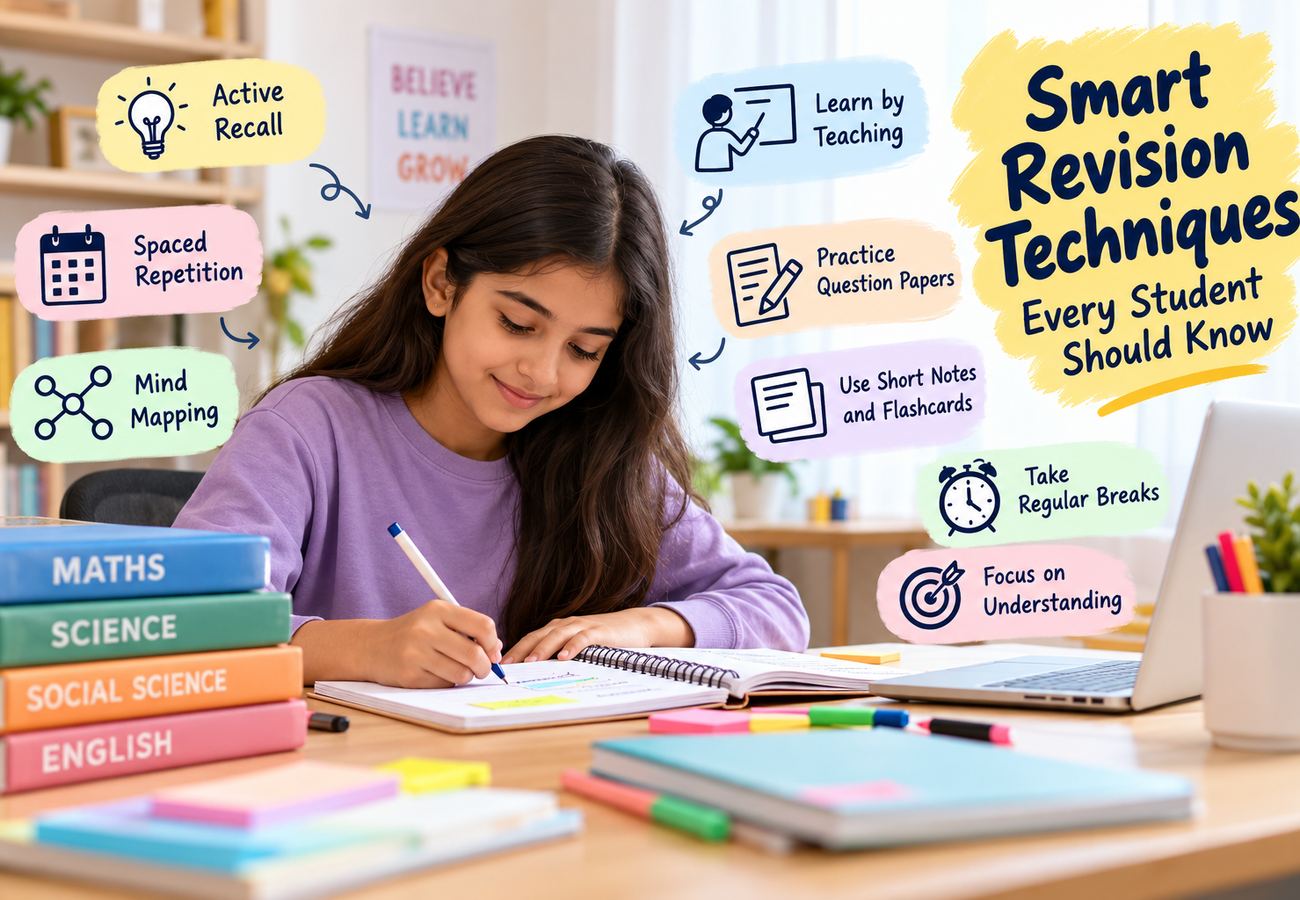
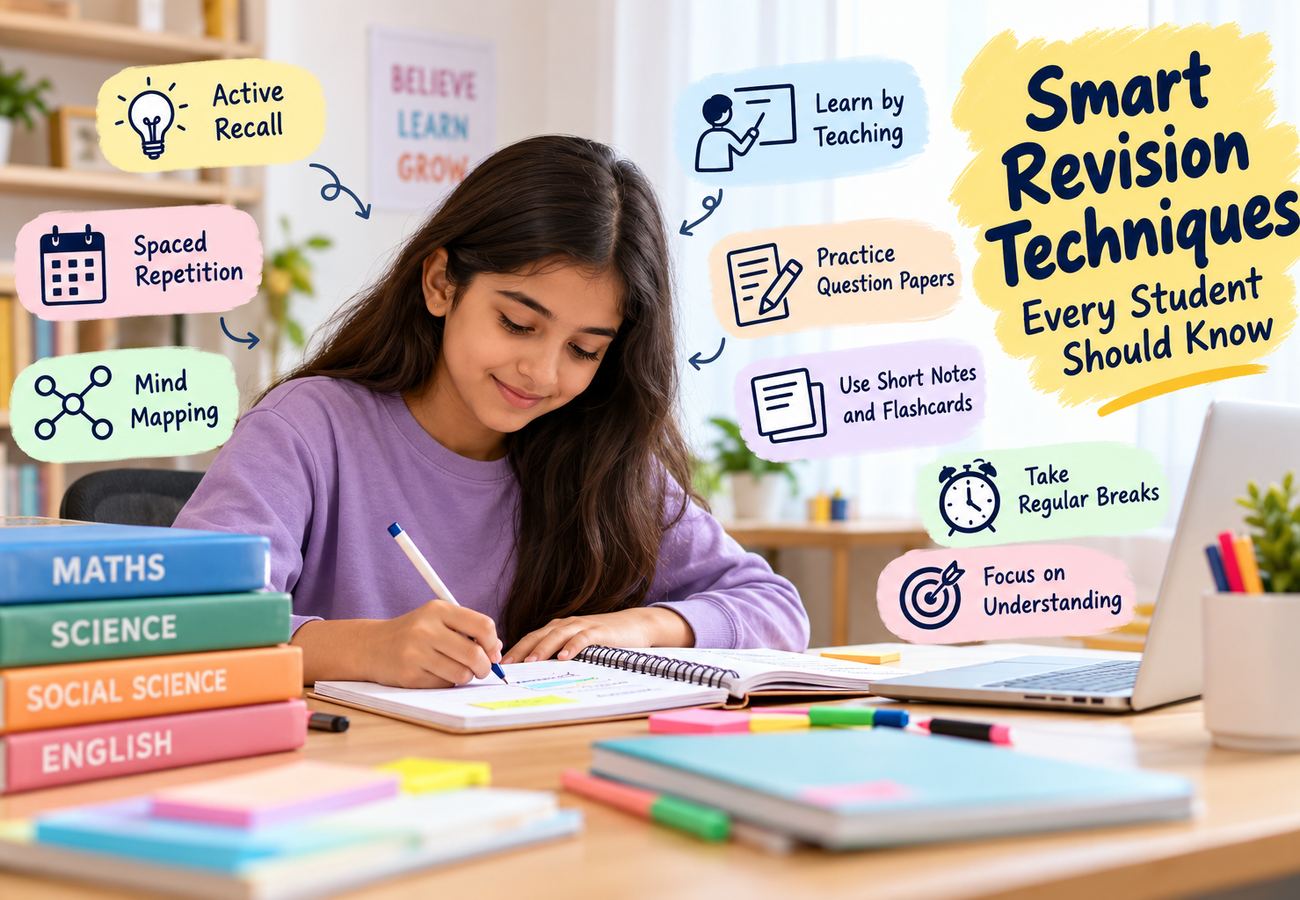
Have you ever spent hours studying a chapter, only to forget important points during an exam? Many students experience this problem. The reason is not always a lack of preparation, but sometimes the way they revise.
Effective revision is not about reading the same textbook repeatedly. It is about understanding concepts, remembering information, and applying knowledge correctly.
With the right revision techniques, students can make their study sessions more productive and approach exams with greater confidence.
Let's explore some smart revision techniques that every student should know.
One of the most effective revision techniques is active recall.
Instead of reading the same notes again and again, students should try to remember information without looking at their textbooks.
For example, after studying a science chapter, close the book and try answering questions about the topic.
This method helps students identify what they remember and which areas require more attention.
Study Tip: After completing a chapter, write down five important questions and try answering them without referring to your notes.
Studying a topic once may not be enough to remember it for a long time.
Spaced repetition involves revising the same information at different intervals rather than studying everything at the last minute.
For example, students can revise a topic on the same day, revisit it after two days, and review it again after a week.
The intervals can be adjusted depending on how easily the student remembers the material.
This technique helps strengthen long-term memory and reduces the need for last-minute cramming.
Some chapters contain large amounts of information, making revision challenging.
Mind mapping helps students organize complex topics into simple visual diagrams.
Students can write the main topic in the centre of a page and connect related concepts using branches, keywords, and short notes.
For example, while studying the human digestive system, students can create separate branches for organs, functions, and processes.
This technique is especially helpful for subjects such as Science, History, and Geography.
Can you explain a topic without looking at your textbook?
If the answer is yes, you probably have a good understanding of the concept.
Teaching a topic to someone else encourages students to organize their thoughts and explain information clearly.
Students can explain a lesson to a friend, sibling, parent, or even pretend they are teaching a classroom.
When they struggle to explain something, it indicates an area that needs further revision.
This technique helps students move beyond memorization and develop deeper conceptual understanding.
Reading and understanding lessons is important, but students must also know how to answer examination questions.
Practising previous year question papers helps students understand question patterns, improve time management, and become familiar with different types of questions.
It also helps them recognize their strengths and identify areas that need improvement.
After completing a question paper, students should review their answers carefully and learn from their mistakes.
Regular practice can make students more comfortable with examination formats.
Revising an entire textbook before an exam can feel overwhelming.
Short notes and flashcards make it easier to review important information quickly.
Students can prepare flashcards containing definitions, formulas, important dates, vocabulary, or key concepts.
For example, one side of a flashcard can contain a question, while the other side contains the answer.
This allows students to test their memory and revise important information in a simple way.
Studying continuously for long periods can affect concentration.
Taking short breaks between study sessions can help students manage fatigue and maintain attention.
One popular approach is the Pomodoro Technique, where students study for 25 minutes and take a 5-minute break.
However, students should adjust their study and break durations according to their concentration levels and learning needs.
A balanced study routine that includes adequate rest and sleep supports effective learning.
Many students memorize answers without fully understanding the concepts behind them.
This may become a problem when examination questions are presented differently from textbook examples.
Instead of memorizing every sentence, students should focus on understanding the meaning of what they study.
For example, in Mathematics, understanding how and why a formula works is more useful than simply remembering the formula.
Conceptual understanding helps students apply their knowledge to unfamiliar questions.
Even students who spend considerable time studying may make mistakes during revision.
Some common mistakes include:
Revising only the night before an exam.
Reading repeatedly without testing memory.
Ignoring difficult chapters.
Memorizing answers without understanding concepts.
Avoiding practice questions.
Studying without sufficient breaks or sleep.
Recognizing and correcting these habits can make revision more effective.
Every student has a unique learning style and pace. While some students understand concepts quickly, others may require additional explanations and practice.
At Skool Guru, we understand the importance of personalized academic support.
Our one-to-one online tuition classes focus on helping students build strong conceptual understanding, identify learning difficulties, and improve their academic skills.
Through individual attention, regular practice, doubt clarification, and progress evaluation, Skool Guru helps students develop effective study habits.
Parents also receive updates about their child's learning progress, helping them stay involved in their academic journey.
https://www.skoolguru.in/blogs/-2026-exam-
Successful exam preparation is not about how many hours students spend studying. It is about how effectively they use their study time.
Smart revision techniques such as active recall, spaced repetition, mind mapping, and question-paper practice can help students remember information, strengthen understanding, and improve examination preparation.
By following a consistent revision routine and focusing on conceptual learning, students can approach their studies with greater confidence.
Study smarter, revise regularly, and learn with confidence!
https://www.skoolguru.in/blogs
Looking for personalized academic support for your child?
Book a Free Assessment & Demo Class with Skool Guru and discover how one-to-one online tuition can help your child learn more effectively.